· Equilibrium Engineering · Engineering · 12 min read
TweekIT v1.8.3 Official Release: PyPI Python SDK, 8-Tool MCP Server, Security & On-Prem Miner Renderery Hardening, and CPUcoin MAITRIX Ultimate AI Hub Architecture
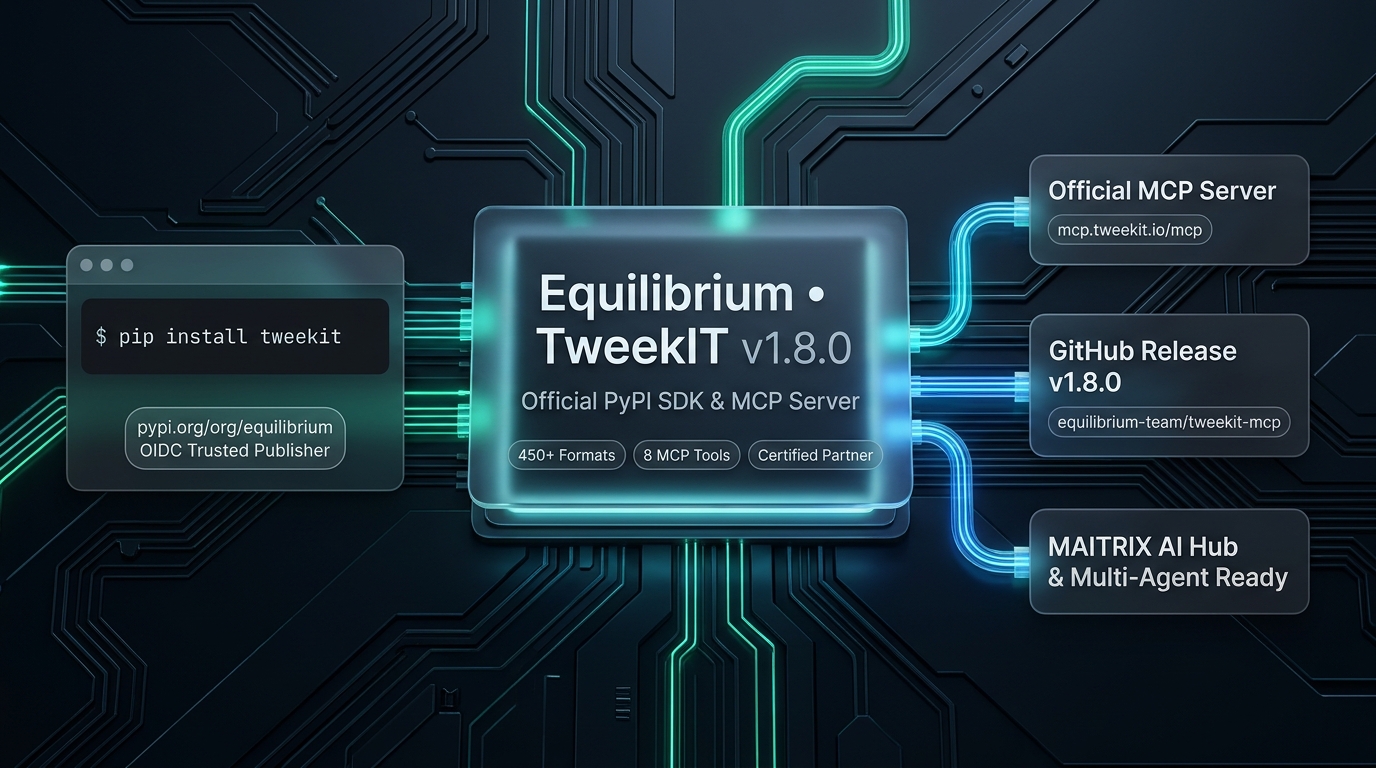
Equilibrium ships tweekit v1.8.3 on PyPI under our AMPS dba Equilibrium organization — introducing the full async Python SDK (TweekitClient & TweekitDirectClient), an expanded 8-tool MCP server with a 347-extension local preflight router backed by 450+ MediaRich engine formats powering CPUcoin's MAITRIX Ultimate AI Hub, zero-cloud-egress On-Premises Miner Renderery support, ABI-resilient Claude Desktop bundles, and v1.8.1–v1.8.3 security hardening.
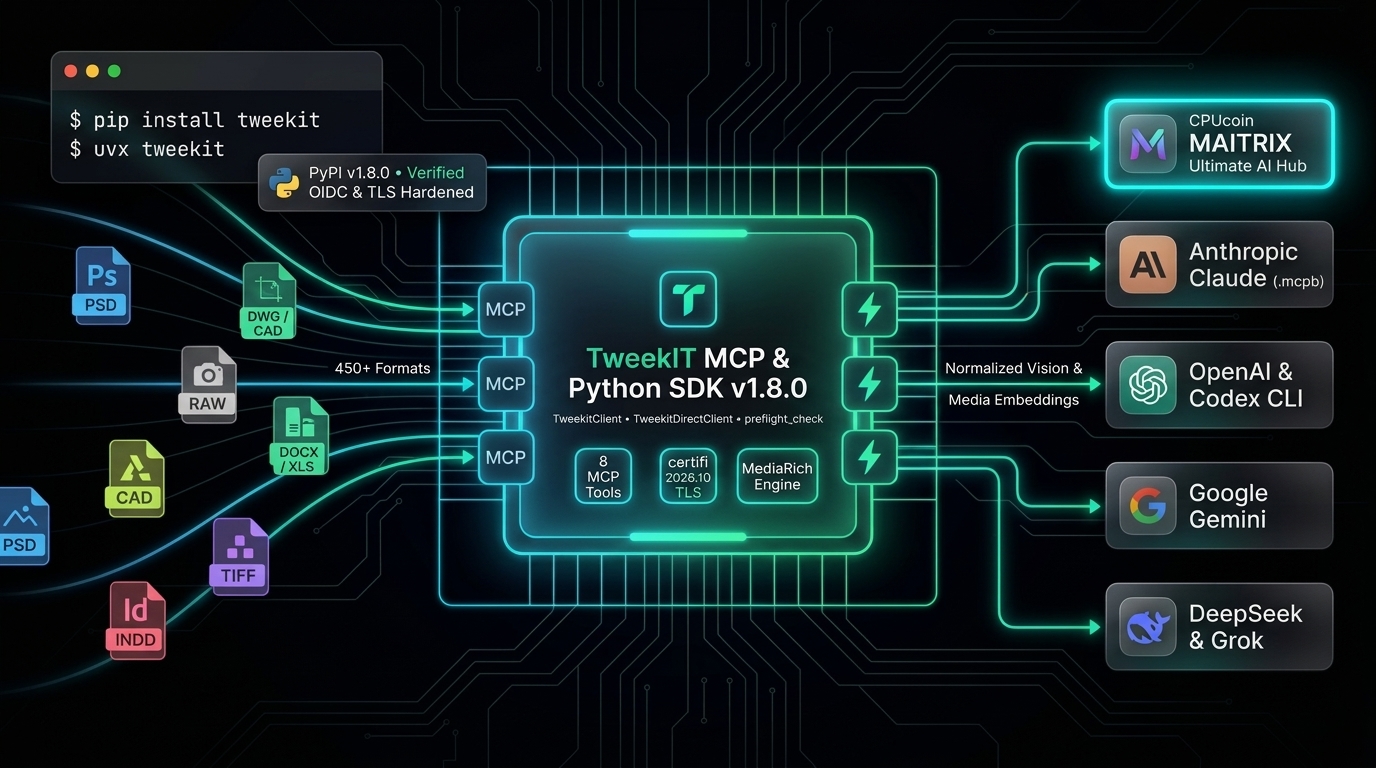
The official TweekIT Python SDK and MCP Server (v1.8.3) is now live on PyPI under the AMPS dba Equilibrium organization — uniting our FastMCP 4.1.6+ server, zero-hop async Python SDK, 347-extension local AI Hub preflight router (backed by 450+ live MediaRich formats), zero-egress On-Premises Miner Renderery connector, ABI-resilient Claude .mcpb desktop extension, and hardened TLS/OIDC release posture in a single open-source package.
Earlier this year, we launched the hosted TweekIT-MCP Server and integrated universal multimodal ingestion across MAITRIX, CPUcoin’s Ultimate AI Hub. Since that initial v1.5.0 release, engineering teams building autonomous agents, RAG pipelines, and multi-model orchestration gateways have asked for three things:
- First-class PyPI packaging with both direct async REST clients (no MCP intermediary hop required) and concurrent MCP client helpers.
- Zero-latency modality preflight & local file tooling so agents know before uploading whether a
.dwg,.psd,.cr3,.indd, or.xlsbfile requires normalization for a specific target LLM — and can convert local files without stuffing megabytes of base64 into the prompt context window. - Hardened release workflows, zero-egress on-premises Miner Renderery execution, and up-to-date TLS trust stores across Python wheels, Docker/Cloud Run images, and desktop
.mcpbbundles.
Today we are excited to announce the general availability of TweekIT MCP Server & Python SDK v1.8.3 on PyPI (pypi.org/project/tweekit/1.8.3/) and GitHub (equilibrium-team/tweekit-mcp). Below is a full technical walkthrough of everything shipping in v1.8.3 (incorporating all v1.6.1–v1.8.3 milestones), our supply-chain and certificate security architecture, and how TweekIT powers real-time multimodal routing inside the CPUcoin MAITRIX Ultimate AI Hub (maitrix.io).
1. Official PyPI Release (pip install tweekit)
tweekit v1.8.3 is published under the AMPS dba Equilibrium organization on PyPI (pypi.org/org/equilibrium/). A single install provides both CLI executables (tweekit and tweekit-mcp) and both Python import namespaces (import tweekit and import tweekit_mcp), supporting Python 3.10 through 3.14+.
# Standard pip install
pip install tweekit

# Fast install with Astral uv
uv pip install tweekit

# Launch as a local stdio MCP server via uvx (preflight/fetch/search work without keys;
# set TWEEKIT_API_KEY and TWEEKIT_API_SECRET for conversion & doctype tools)
uvx tweekit --transport stdio

# Or launch in zero-cloud-egress On-Premises / Localhost Miner Renderery mode
uvx tweekit --local-miner --transport stdio

# Install globally as an isolated CLI tool (exposes both `tweekit` and `tweekit-mcp`)
uv tool install tweekit
To run a stateless streamable HTTP MCP server locally or inside your own VPC:
export TWEEKIT_API_KEY="<TWEEKIT_API_KEY>"
export TWEEKIT_API_SECRET="<TWEEKIT_API_SECRET>"

tweekit-mcp --transport streamable-http --host 0.0.0.0 --port 8080
Under the hood, v1.8.3 runs on FastMCP 4.1.6+ (fastmcp>=4.1.6) with stateless_http=True enabled across local HTTP, Google Cloud Run, and Firebase Hosting deployments — eliminating sticky-session state overhead and enabling horizontal autoscaling from zero.
| Package Metadata | Value |
|---|---|
| PyPI Package | tweekit (v1.8.3) |
| PyPI Organization | Equilibrium (AMPS dba Equilibrium) |
| CLI Entry Points | tweekit, tweekit-mcp |
| Python Namespaces | tweekit, tweekit_mcp, clients.python |
| Supported Python Versions | >=3.10 (3.10, 3.11, 3.12, 3.13, 3.14+) |
| MCP Registry Identifier | io.github.equilibrium-team/tweekit (server.json schema 2025-12-11) |
| Hosted MCP Endpoint | https://mcp.tweekit.io/mcp (and /mcp/ — Streamable HTTP) |
| License | MIT |
2. Full Async Python SDK: TweekitDirectClient & TweekitClient
Prior to v1.8.0, developers embedding TweekIT into Python backends either wrote raw httpx boilerplate against the REST API or stood up an MCP client session even for deterministic backend pipelines. tweekit v1.8.0 ships two purpose-built async SDK clients plus synchronous preflight utilities:
preflight_check/recommend_ai_format: Pure-Python, zero-network-roundtrip file classification across 347 static extensions (EXTENSIVE_SUPPORTED_EXTENSIONS, spanning 12 media families) with provider-specific output format and parameter recommendations — backed by 450+ formats in the live MediaRich engine viadoctype.TweekitDirectClient: Calls the TweekIT MediaRich REST engine directly overhttpxwith zero MCP protocol overhead — ideal for high-throughput ingestion workers, ETL jobs, and backend microservices.TweekitClient: Wraps the FastMCP async client againsthttps://mcp.tweekit.io/mcp(or any custom/stdio server) and adds semaphore-controlledbatch_convert()for concurrent multi-asset normalization across local paths, remote URLs, and raw byte buffers.
import asyncio
from pathlib import Path
from tweekit import (
    TweekitClient,
    TweekitDirectClient,
    preflight_check,
)

# 1. Instant local preflight & AI provider format routing (0 ms network cost)
route = preflight_check("turbine_assembly.dwg", target_provider="claude")
print(route["supported"], route["category"], route["recommended_outfmt"])
# -> True design_vector_cad png

# 2. Direct Async REST SDK (no MCP intermediary hop required)
async def normalize_direct() -> None:
    async with TweekitDirectClient() as api:
        receipt = await api.convert_file(
            Path("board_deck.ppt"),
            outfmt="pdf",
            no_rasterize=True,
            output_path=Path("board_deck_ai_ready.pdf"),
        )
        print("Normalized directly to disk:", receipt)

# 3. Async MCP SDK with semaphore-governed concurrent batch_convert
async def normalize_batch_mcp() -> None:
    async with TweekitClient() as mcp_client:
        tools = await mcp_client.list_tools()
        results = await mcp_client.batch_convert(
            [
                {"url": "https://example.com/archive_scan.tiff", "outfmt": "png", "width": 1600},
                {"path": "financial_model.xlsb", "outfmt": "pdf", "no_rasterize": True},
                {"path": "studio_shot.cr3", "outfmt": "webp", "width": 1200, "bgcolor": "#FFFFFF"},
            ],
            concurrency=5,
        )
        print(f"Connected ({len(tools)} tools); converted {len(results)} assets.")

async def main() -> None:
    await normalize_direct()
    await normalize_batch_mcp()

asyncio.run(main())
3. Expanded 8-Tool MCP Surface with Spec ToolAnnotations
The TweekIT MCP server has grown from its original 3 conversion tools into an 8-tool multimodal ingestion suite, with every tool now carrying explicit Model Context Protocol ToolAnnotations (readOnlyHint, destructiveHint, idempotentHint, openWorldHint). Autonomous agent runtimes (Claude Desktop, OpenAI Codex CLI, Cursor, Antigravity, Windsurf, and custom MCP hosts) use these annotations to auto-approve safe read-only preflight probes while gating destructive cleanup operations.
| MCP Tool | Added / Updated | Safety Hints (readOnly / destructive / idempotent) | Engineering Purpose |
|---|---|---|---|
preflight | New in v1.8.0 | True / False / True | Classifies any filename, path, or extension locally (openWorldHint=False) against TweekIT’s 347-extension static FORMAT_TAXONOMY (12 media families) and returns needs_conversion, recommended_outfmt, and suggested_params for the target AI provider (claude, openai, gemini, mistral, grok, deepseek, openrouter, or default). |
convert_file | New in v1.8.0 | False / False / True | Reads a local file from disk, normalizes it via TweekIT, and optionally writes the output directly to output_path — returning a compact JSON receipt (size_bytes, output_path) instead of inflating the LLM context window with base64 payloads. Guarded by TWEEKIT_ALLOW_LOCAL_FILES (0 to disable on untrusted multi-tenant hosts). |
delete_document | Added in v1.7.0 | False / True / True | Immediately purges an uploaded REST workspace document by docId (DELETE /api/image/{docId}) prior to TweekIT’s automatic 20-minute TTL expiration — essential for compliance-sensitive workflows and user-cancelled multi-page jobs. |
convert | Core (v1.5+ / v1.8) | False / False / True | Stateless base64-in → FastMCP Image/File-out conversion supporting pixel width/height aspect-preserving resize, crop/padding coordinates (x1, y1, x2, y2), multi-page extraction (page), noRasterize searchable PDF output, and alpha/bgColor compositing. |
convert_url | Core (v1.5+ / v1.8) | False / False / True | Downloads remote assets over HTTP(S) with custom fetchHeaders (e.g., signed S3/GCS or Bearer tokens), infers input type from URL or Content-Type, and normalizes in a single call. |
doctype | Core (v1.5+ / v1.8) | True / False / True | Queries the live TweekIT MediaRich engine (extension="*" or specific extension; openWorldHint=True) to inspect 450+ supported input/output format mappings dynamically. |
fetch | Core (v1.5+ / v1.8) | True / False / True | Retrieves remote HTTP(S) resources and returns typed FastMCP Image, File(format="pdf"), or structured { url, status, content_type, text } JSON. |
search | Core (v1.5+ / v1.8) | True / False / True | Lightweight zero-key DuckDuckGo HTML search helper returning { title, url, snippet } results that chain directly into convert_url. |
In addition, the server exposes three lightweight MCP resources — config://tweekit-version (live upstream MediaRich/TweekIT engine probe), config://tweekit-mcp-version (1.8.3), and config://tweekit-runtime-mode (inspecting active Cloud CGN vs. On-Premises Miner Renderery mode, zero-egress enforcement, and sandbox boundaries) — plus an updated FastAPI OpenAI / ChatGPT REST Plugin Proxy (plugin_proxy.py) adding GET /preflight, POST /convert-url, and DELETE /documents/{doc_id} with strict Content-Security-Policy headers.
4. Inside the CPUcoin MAITRIX Ultimate AI Hub Integration
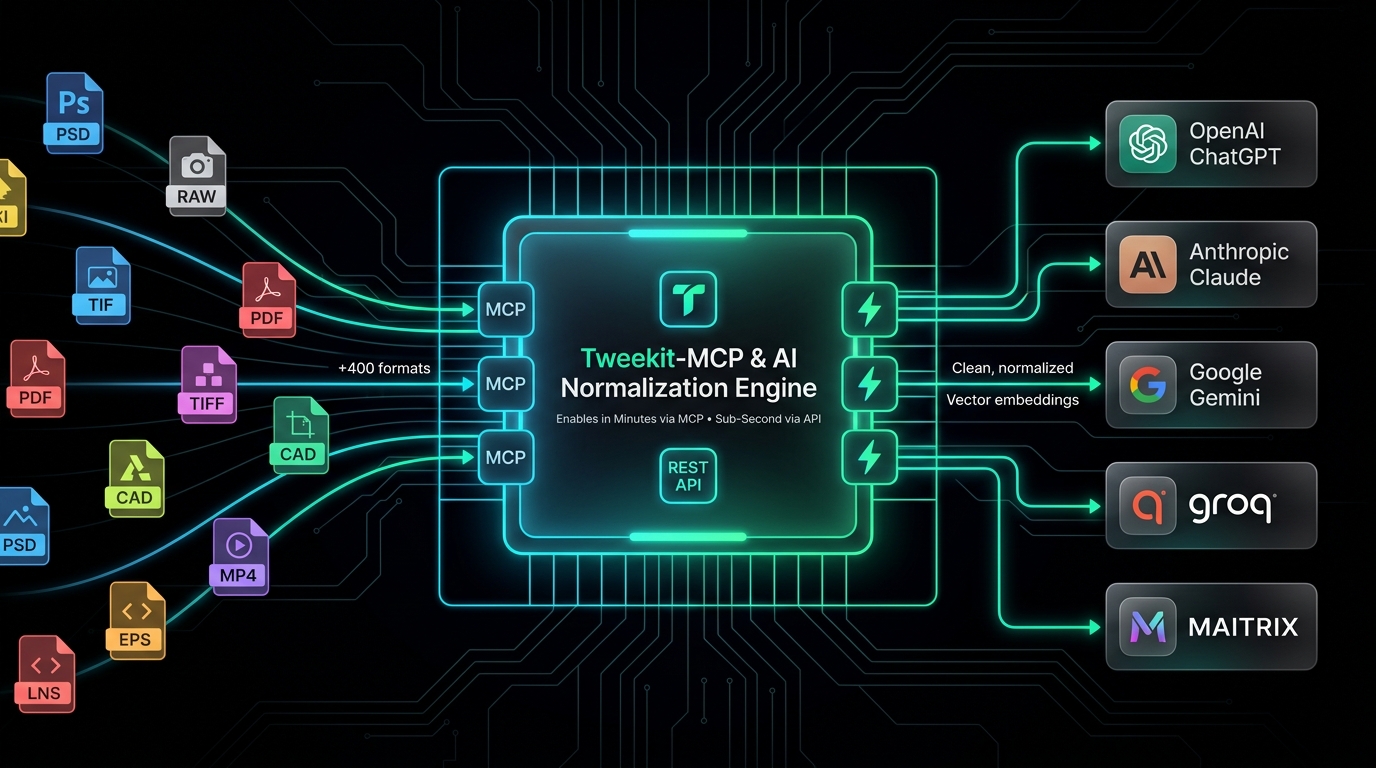
When CPUcoin launched MAITRIX (maitrix.io) — the Ultimate AI Hub unifying 70+ frontier models from OpenAI, Anthropic, Google Gemini, xAI Grok, Meta Llama, Mistral, DeepSeek, Groq, and NVIDIA Nemotron inside a single web, iOS, Android, and desktop workspace — one architectural problem stood above all others: modality asymmetry across frontier models.
Every LLM provider enforces different native MIME rules:
- Drop an AutoCAD
.dwg, Photoshop.psd, InDesign.indd, or Canon.cr3Camera RAW file into a standard chat client and every frontier API rejects the request outright. - Even for office documents (
.doc,.xlsx,.pptx,.wpd,.odt,.vsdx), some model endpoints accept native PDF documents while vision-only model lanes (such as DeepSeek vision or specialized Mistral/open-weight vision endpoints) only accept raster image URLs (image/png,image/webp,image/jpeg). - Worse, in MAITRIX, a user can switch agents mid-conversation — starting a design critique on Page 3 of an Illustrator package with GPT, switching to Claude for structural spec extraction, and handing off to Gemini or DeepSeek on the very next turn.
How FORMAT_TAXONOMY, AI_PROVIDER_PROFILES, and justTweekIT Solve Multi-Model Ingestion
tweekit v1.8.3 open-sources the exact 12-category, 347-extension local preflight taxonomy (FORMAT_TAXONOMY / EXTENSIVE_SUPPORTED_EXTENSIONS) and provider modality router (AI_PROVIDER_PROFILES) co-engineered with the MAITRIX platform (backed by 450+ dynamic MediaRich engine formats via doctype):
- Taxonomy Classification Across 12 Media Families: Incoming attachments are classified across
raster_image(HEIC, AVIF, JP2, EXR, HDR, JBIG2, TIFF, WBMP…),design_vector_cad(PSD, PSB, AI, EPS, CDR, DWG, DXF, IGES, STL…),camera_raw(CR2, CR3, NEF, ARW, DNG, RAF, ORF, RW2, IIQ…),document(DOC/DOCX, WPD, HWP/HWPX, DJVU, XPS, RTF, LaTeX…),spreadsheet(XLS/XLSB/XLSM, ODS, Numbers, Lotus 1-2-3, SYLK…),presentation(PPT/PPTX, Keynote, ODP…),diagram_publishing(Visio VSD/VSDX, InDesign INDD/IDML, QuarkXPress, FrameMaker…),ebook_help(EPUB, MOBI, AZW3, CHM…),email_message(EML, MSG, MBOX, VCF, ICS),web_code_data,archive, andaudio_video. - Provider-Aware Output Selection: When a file isn’t natively supported by the active model, MAITRIX’s
BaseProvider.justTweekIT()pipeline routes visual/CAD/RAW assets to high-fidelitypng/webpderivatives, routes textual documents tonoRasterize=Truesearchable PDFs for document-capable models (claude,openai,gemini,openrouter), and automatically renders multi-page documents page-by-page (TWEEKIT_DPI,TWEEKIT_DOCUMENT_PAGE_LIMIT) into crisp raster pages for vision-only models (deepseek,mistralimage lanes) — even parsing natural-language page requests from the user’s prompt. - Content-Addressed Caching & Ephemeral Cleanup: MAITRIX computes a content hash of every uploaded source file so normalized page derivatives are reused instantly when switching models mid-chat, streams live
"TweekIT: Normalizing..."progress updates to the user’s session, and invokesDELETE /api/image/{docId}(purgeTweekitDocument/delete_document) immediately if a multi-page job is cancelled or finishes early. - Decentralized Edge Compute via CPUcoin PoPW: Heavy rendering and format normalization execute through Equilibrium’s patented MediaRich® / MediaGen engine distributed across the CPUcoin Computing Global Network (CGN) — where enterprise Proof of Processed Work (PoPW) nodes inside SOC 2 / ISO 27001 data centers deliver up to 5× higher throughput and up to 90% lower compute cost than traditional hyperscale serverless functions.
5. Security Hardening, On-Premises Miner Renderery & Supply-Chain Integrity (v1.8.1 → v1.8.3)
Security and supply-chain integrity are first-class engineering requirements in v1.8.3. Incorporating feedback from official MCP Registry liveness probes and automated static/dependency audits, v1.8.1 through v1.8.3 introduce six defense-in-depth upgrades:
- Credential-Free LLM Tool Schemas & Atomic Header Auth: Removed
apiKey/apiSecretfrom all MCP tool schemas and OpenAPI request bodies so secrets never appear in LLM prompt contexts or tool-call logs; added atomicApiKey/ApiSecretHTTP request header authentication that fails closed on partial headers. - Connect-Time DNS IP Pinning (
_PinnedPublicDNSBackend) & SSRF Protection: Enforcedhttps://-only remote fetches, blocked loopback/private/link-local/CGNAT/cloud-metadata (169.254.169.254,metadata.google.internal) and IPv6 transition prefixes (::ffff:0:0/96, NAT6464:ff9b::/96, 6to42002::/16, Teredo2001::/32) on every redirect hop, pinned the validated DNS IP at socket connect time to eliminate DNS rebinding TOCTOU windows, restrictedfetchHeadersto a 6-header allowlist, and capped downloads at 50 MiB. - Opt-In
O_NOFOLLOWWorkspace Sandbox forconvert_file: Disabled local file reads by default (TWEEKIT_ALLOW_LOCAL_FILES=0unless explicitly set to1), confined reads/writes toTWEEKIT_ALLOWED_DIRSviaos.path.realpath, verified open descriptors viaO_NOFOLLOW+os.path.samefile, blocked dotfiles and IDE/agent config directories (.ssh,.aws,.gnupg,.kube,.docker,.git,.claude,.cursor,.codex,.gemini,.windsurf,.continue,.vscode,.idea,.env*,*credentials*,*secret*,*.pem,*.key), and enforcedO_CREAT | O_EXCL | O_NOFOLLOWoverwrite protection. - Default Zero-Cloud-Egress On-Premises Miner Renderery (
--local-miner/local_miner=True): Connectstweekit-mcpandTweekitDirectClient(local_miner=True)directly to an on-premisesTweekIT_API(NOAUTH;NODB) +CGNMinerMediaRich CORE™ V7 engine (http://127.0.0.1:16377/api/image/orhttp://127.0.0.1:5000/api/image/). Inv1.8.3, enabling--local-miner,TWEEKIT_MINER_LOCAL=1, orlocal_miner=TrueenforcesTWEEKIT_LOCAL_ONLY=1zero-cloud-egress mode by default (blockingconvert_url,fetch, andsearch), rejects0.0.0.0/::wildcard listeners, and pairs withTweekIT_API’s127.0.0.1:5000loopback Kestrel binding. - Streamable HTTP
/mcp/Trailing-Slash In-Place Routing:_NormalizeTrailingSlashMCPMiddlewarenormalizes/mcp/to/mcpin-place soPOST https://mcp.tweekit.io/mcp/returns200 OKwithout a307redirect or HTTP downgrade. - Zero-CVE Dependency Floor, Sigstore PEP 740 Attestations & October 2026 TLS CA Floor: Upgraded to
fastmcp>=4.1.6(fixingCVE-2026-27124andGHSA-7xgj-8392-5q4r),mcp>=2.3.0,fastapi>=0.162.2,starlette>=1.10.0,httpcore>=1.0.9,uvicorn>=0.54.0, andcertifi>=2026.10.23, and enabled keyless GitHub OIDC Sigstore PEP 740 provenance attestations (attestations: true) on PyPI.
6. ABI-Resilient Claude Desktop .mcpb Bundle & Multi-Client Setup
Desktop AI users on macOS and Linux frequently hit a subtle failure mode with compiled Python MCP extensions: when a package manager like Homebrew upgrades the system python3 binary (for example, from Python 3.14 to Python 3.15), static .mcpb bundles containing compiled Cython/Rust wheels such as pydantic_core (_pydantic_core.cpython-314-darwin.so) can fail at startup with ModuleNotFoundError.
In v1.8.3, scripts/build_claude_bundle.py ships a pure-stdlib ABI-resilient bootstrap launcher inside dist/tweekit-claude.mcpb:
- At startup, the launcher probes
pydantic_coreandfastmcpC-extension ABI compatibility in-process before importing the server. - If the host
python3minor version changed, it inspects the bundled wheel tags and seamlesslyos.execve()re-execs into a matching local interpreter (e.g.,/opt/homebrew/bin/python3.14), an isolated~/.local/bin/tweekit-mcptool binary, oruvx --from tweekit tweekit-mcp— preventing broken desktop connectors across Python minor-version upgrades and avoiding working-directory import collisions when launched from macOS protected folders.
Connect Any MCP Client in Seconds
Cursor (~/.cursor/mcp.json — Hosted Streamable HTTP):
{
  "mcpServers": {
    "tweekit": {
      "url": "https://mcp.tweekit.io/mcp",
      "headers": {
        "ApiKey": "${env:TWEEKIT_API_KEY}",
        "ApiSecret": "${env:TWEEKIT_API_SECRET}"
      }
    }
  }
}
Claude Desktop / Cursor / Antigravity (claude_desktop_config.json / mcp_config.json — Local stdio via PyPI + uvx):
{
  "mcpServers": {
    "tweekit": {
      "command": "uvx",
      "args": ["tweekit", "--transport", "stdio"],
      "env": {
        "TWEEKIT_API_KEY": "<TWEEKIT_API_KEY>",
        "TWEEKIT_API_SECRET": "<TWEEKIT_API_SECRET>"
      }
    }
  }
}
(On macOS GUI apps with a minimal PATH, point "command" to /opt/homebrew/bin/uvx or ~/.local/bin/uvx, or install dist/tweekit-claude.mcpb directly in Claude Desktop via Settings → Extensions.)
OpenAI Codex CLI (~/.codex/config.toml — forwards env vars without storing secrets on disk):
# Hosted Streamable HTTP endpoint (authenticated via env_http_headers)
[mcp_servers.tweekit]
url = "https://mcp.tweekit.io/mcp"
env_http_headers = { "ApiKey" = "TWEEKIT_API_KEY", "ApiSecret" = "TWEEKIT_API_SECRET" }

# Or local stdio server via uvx (v1.8.3 exposes all 8 tools)
# [mcp_servers.tweekit]
# command = "uvx"
# args = ["tweekit", "--transport", "stdio"]
# env_vars = ["TWEEKIT_API_KEY", "TWEEKIT_API_SECRET"]
Get Started Today — 10,000 Free API Calls Included
Every new TweekIT developer account includes 10,000 free API calls with full access to all 8 MCP tools, the async Python SDK, and 450+ supported formats — no credit card required.
- Install from PyPI (
v1.8.3):pypi.org/project/tweekit/1.8.3/(pip install tweekit) - Equilibrium PyPI Organization:
pypi.org/org/equilibrium/ - Release Overview & Checksums: Official PyPI & Certified Partner Code Release Overview
- Source &
v1.8.3Release Assets:github.com/equilibrium-team/tweekit-mcp/releases/tag/v1.8.3·Repository - TweekIT MCP Server Site & Endpoint:
tweekit.io/mcp(https://mcp.tweekit.io/mcp) ·Official MCP Registry(livev0JSON search result) - Get Free API Credentials & Interactive Demo:
tweekit.io - Experience TweekIT Live Inside MAITRIX Ultimate AI Hub:
maitrix.io - Explore Enterprise On-Premises MediaRich & MCP Deployments: Contact Equilibrium Engineering · Supported File Formats · Developer Center